
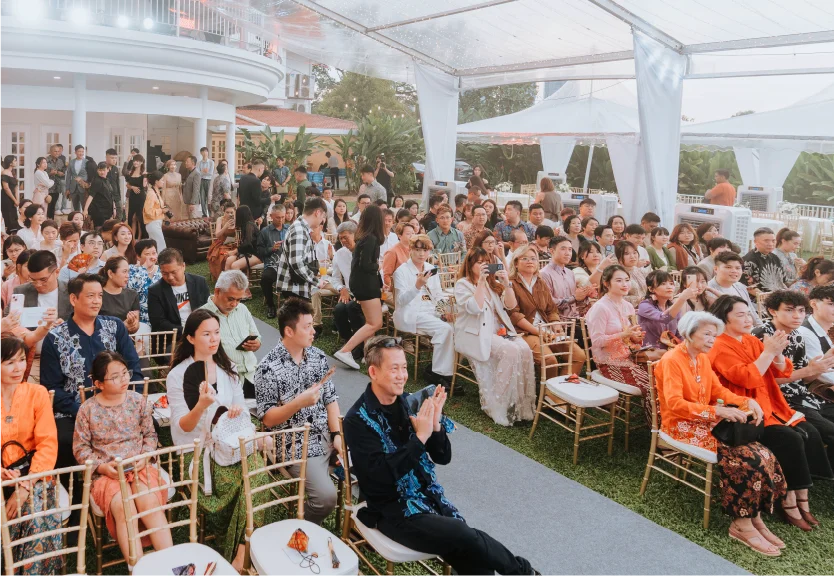
Four traditions, four spaces, one property: at The Estate on Federal Hill, a Muslim akad nikah, a Chinese tea ceremony and banquet, a Hindu or Sikh mandap ceremony, and a Malay bersanding celebration have each, in practice, found a natural fit somewhere across the Great Hall, the Hilltop Garden, the Sky Balcony, and the Private Room. This FAQ answers, question by question, which space suits which tradition, and how multicultural or interfaith weddings are actually planned here.
This is deliberately not a pricing or booking-logistics guide — that ground is already covered thoroughly in the estate's pricing, capacity, and booking FAQ. What follows instead is a tradition-first guide: for each major wedding tradition hosted at the estate, which space fits, why, and where to go for the full depth on that specific ceremony.
The short version, before the question-by-question detail: a heritage property with four genuinely different spaces — an indoor Great Hall, an open Hilltop Garden, a skyline-facing Sky Balcony, and an intimate Private Room — has room to let each tradition's ceremonial requirements shape where it happens, rather than forcing every wedding, regardless of culture, into the same single ballroom format. That flexibility is the difference between a venue that markets itself as "multicultural" and one that has actually hosted the traditions it claims to welcome.
The table below is a quick-reference map before the full Q&A — each tradition's typical ceremony space, and the companion article with the full depth on that tradition specifically:
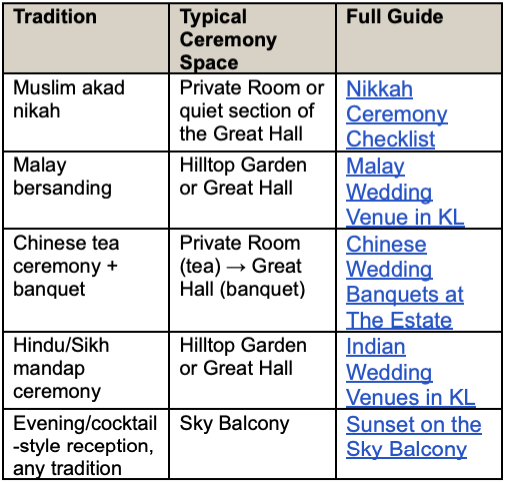
Use it as a starting orientation, not a final answer — guest count, whether the ceremony is indoor or outdoor by preference, and whether the wedding combines more than one tradition will all shift the recommendation, which is exactly what the questions below work through in detail.
It comes down to having more than one kind of space, and a history that already sits outside any single cultural template. The Estate on Federal Hill was built in 1950 as a residential property and later served as the official residence for the general managers of the Socfin Group before its conversion into an event venue in 2019 — which means its architecture was never designed around one wedding format to begin with, unlike a purpose-built hotel ballroom.
Practically, that translates into genuine choice: an indoor Great Hall for ceremonies that call for a controlled, formal setting; an open-air Hilltop Garden spanning 9,000 square feet for large outdoor ceremonies and receptions; a skyline-facing Sky Balcony for evening celebrations; and a more intimate Private Room for smaller rites or family-only portions of a multi-part wedding. Different traditions place different demands on space — a tea ceremony needs proximity and quiet, a bersanding needs a dais and open sightlines, a mandap needs room for a fire ritual and surrounding family seating — and having four distinct spaces means those demands can actually be met rather than compromised on.
The estate's setting adds a layer that a hotel ballroom simply cannot offer regardless of how many rooms it has: seventy years of colonial-era architecture, retained rather than renovated away, sitting on 9 acres of tropical rainforest plantation land on Federal Hill. A tea ceremony held in a room with genuine architectural history reads differently than one held in a function room built the same year as the wedding. That's a large part of why couples researching a multicultural wedding venue in Kuala Lumpur increasingly land here — not because the venue claims to be culturally inclusive in a single marketing line, but because it has the physical range, and the published proof, to back that claim up tradition by tradition.
The akad nikah — the formal solemnisation — is typically hosted in a more intimate, contained space such as the Private Room or a quieter section of the Great Hall, given its formal, witnessed, and relatively brief nature, while the reception that follows can scale up into the Great Hall or Hilltop Garden depending on guest count. Our detailed Nikkah Ceremony Checklist walks through the akad nikah step by step, from documentation to the ceremony itself, and is the right starting point for couples planning that part of the day specifically.
For the celebration that follows the akad — particularly the bersanding dais, cultural performances, and guest hosting — our companion piece on Malay wedding venues and bersanding traditions covers how that side of a Muslim Malay wedding maps onto the estate's spaces in far more depth than this FAQ can.
A Chinese tea ceremony calls for a more intimate, close-quarters setting where the couple can move between family members' seats, which tends to suit the Private Room or a defined corner of the Great Hall well, before the event opens into a larger banquet-style reception. The banquet portion, with its round-table seating and multi-course service, generally fits the Great Hall's 3,100 square feet comfortably for 50 to 100 guests.
The full detail on how a tea ceremony and banquet structure works at the estate — including how heritage architecture and tea ceremony tradition sit together — is covered in Chinese Wedding Banquets at The Estate, which is the more thorough companion read for couples planning this specific tradition.
Hindu and Sikh wedding ceremonies typically require more open floor space than other traditions to accommodate a mandap structure, a processional entrance (baraat), and seating for extended family around the ceremonial area — which points toward the Hilltop Garden for larger multi-day celebrations, or the Great Hall for a more contained indoor version of the same structure. Indian weddings in Kuala Lumpur are also frequently multi-day events, spanning several ceremonies rather than a single day, which the estate's four-space layout is well suited to hosting across consecutive functions.
Indian Wedding Venues in Kuala Lumpur goes into detail on hosting a multi-day Hindu or Sikh celebration at the estate, including how different ceremonies within the same wedding can be distributed across different spaces on different days.
The bersanding — the traditional dais ceremony where the couple is enthroned and celebrated — needs open sightlines so guests can properly witness the couple on the pelamin, along with room for cultural performances such as silat, which makes the Hilltop Garden or Great Hall the natural choices depending on guest count and whether the celebration is indoor or outdoor. Malay Wedding Venue in Kuala Lumpur: Bersanding Traditions at a Heritage Estate covers dais staging, traditional performances, and guest hosting for this specific tradition in full, and is the deeper read if bersanding is the ceremony you're planning around.
For a sense of how an entire Malay wedding day — akad nikah through bersanding to evening reception — actually unfolds in practice, A Malay Wedding Day at The Estate walks through a full, composite day start to finish.
Yes — interfaith and cross-cultural weddings, where two families bring different traditions into a single celebration, are entirely achievable at a venue with more than one space to work with. In practice this often means running one tradition's ceremony in one space (say, a tea ceremony in the Private Room) and a second tradition's rites or reception elsewhere (a bersanding dais in the Hilltop Garden), or blending both families' styling and catering traditions within a single reception format.
Styling for a blended-tradition wedding benefits from thinking about the full day as one visual story rather than two separate events stitched together — our Wedding Photography & Videography Styling Guide and the piece on designing an evening celebration on the Sky Balcony both cover styling and lighting choices that hold together across a multi-tradition day, particularly if the celebration runs from an afternoon ceremony into an evening reception.
This depends on the tradition and the couple's preference — some ceremonies (a mosque solemnisation, a temple rite) are tied to a specific religious location and lead into a reception-only booking elsewhere, while other traditions, like a Hilltop Garden bersanding or a Great Hall tea ceremony and banquet, are commonly held on-site as one continuous full-day booking. Our guide to reception-only versus full wedding package bookings breaks down exactly what each booking type includes and which spaces suit each, and is worth reading once you know where your ceremony itself will take place.
Pricing at the estate is not tradition-specific — it's driven by guest count, which spaces and how many are booked, the date, and any additional services, regardless of whether the wedding is a Muslim, Chinese, Indian, Malay, or blended celebration. No public price list exists for any tradition, by design, since every wedding's scope differs. The full breakdown of what affects cost, and how to request a personalised quote, is in the estate's pricing and capacity FAQ — this hub exists to answer the tradition-and-space question, not to duplicate that pricing detail.
The clearest illustration is a composite Malay wedding day — akad nikah in the morning, bersanding dais ceremony and traditional performances through the afternoon, and an evening reception — laid out in full in A Malay Wedding Day at The Estate. For a broader, tradition-independent look at how a wedding day unfolds at the estate from morning preparation through to the last dance, A Wedding Day at The Estate covers the general structure that any tradition's celebration is built around.
It's also worth noting that The Estate on Federal Hill isn't exclusively a wedding venue — the same flexible spaces that adapt to different wedding traditions also host adult milestone birthday celebrations and private events (see Milestone Birthday & Private Celebrations), and even large-scale private screening events, such as the venue's established private sports viewing offering built around FIFA World Cup 2026. The same adaptability that makes the property work across wedding traditions is what makes it work across event types more broadly.
As a general rule, the more traditions or ceremonies a wedding combines, the earlier it should be booked — a single-ceremony reception-only wedding has more scheduling flexibility than a multi-day Hindu or Sikh celebration, or a wedding that needs both an akad nikah space and a separate bersanding and reception space secured on the same date. Popular dates, particularly weekends and festive-season weekends, are the first to fill, so couples planning a multicultural or multi-part celebration are best served by reaching out early with a rough guest count and list of ceremonies in mind, so the team can map which spaces and dates realistically fit.
---
Not sure which space fits your specific wedding traditions? The fastest way to get a direct answer is a WhatsApp inquiry — describe your ceremony or ceremonies and guest count, and the team will point you to the right space combination. For a formal proposal or multi-date request, send a request instead. The Estate on Federal Hill is located at 333 Jalan Damansara, on Federal Hill in Bangsar, Kuala Lumpur — in person is still the best way to see how the Great Hall, Hilltop Garden, Sky Balcony, and Private Room each hold a different tradition.