
A traditional Chinese wedding banquet works best across three distinct settings in a single day: an intimate indoor room for the tea ceremony, an open garden for door games and a cocktail reception, and a grand hall for the seated banquet and toasting. Most couples searching for a Chinese wedding venue in Kuala Lumpur are shown a narrower choice a hotel ballroom that has to serve as all three at once, reconfigured between segments with function-room furniture and standard lighting.
There is a real alternative to that setup, and it's one that direct search results for "Chinese wedding venue KL" currently miss almost entirely: a heritage estate where the tea ceremony, the reception, and the banquet each get their own space, each with genuine architectural character rather than a repurposed conference room. That's the model this article walks through how a traditional Chinese wedding, ritual by ritual, maps onto the actual rooms and grounds of a heritage venue.
For context, a full Chinese wedding day typically includes door games at the groom's arrival, a tea ceremony honouring both families, a cocktail or mingling period, and a formal multi-course banquet with toasting. Each of these has a natural home within a property built around distinct indoor and outdoor spaces which is the case we'll make section by section below.
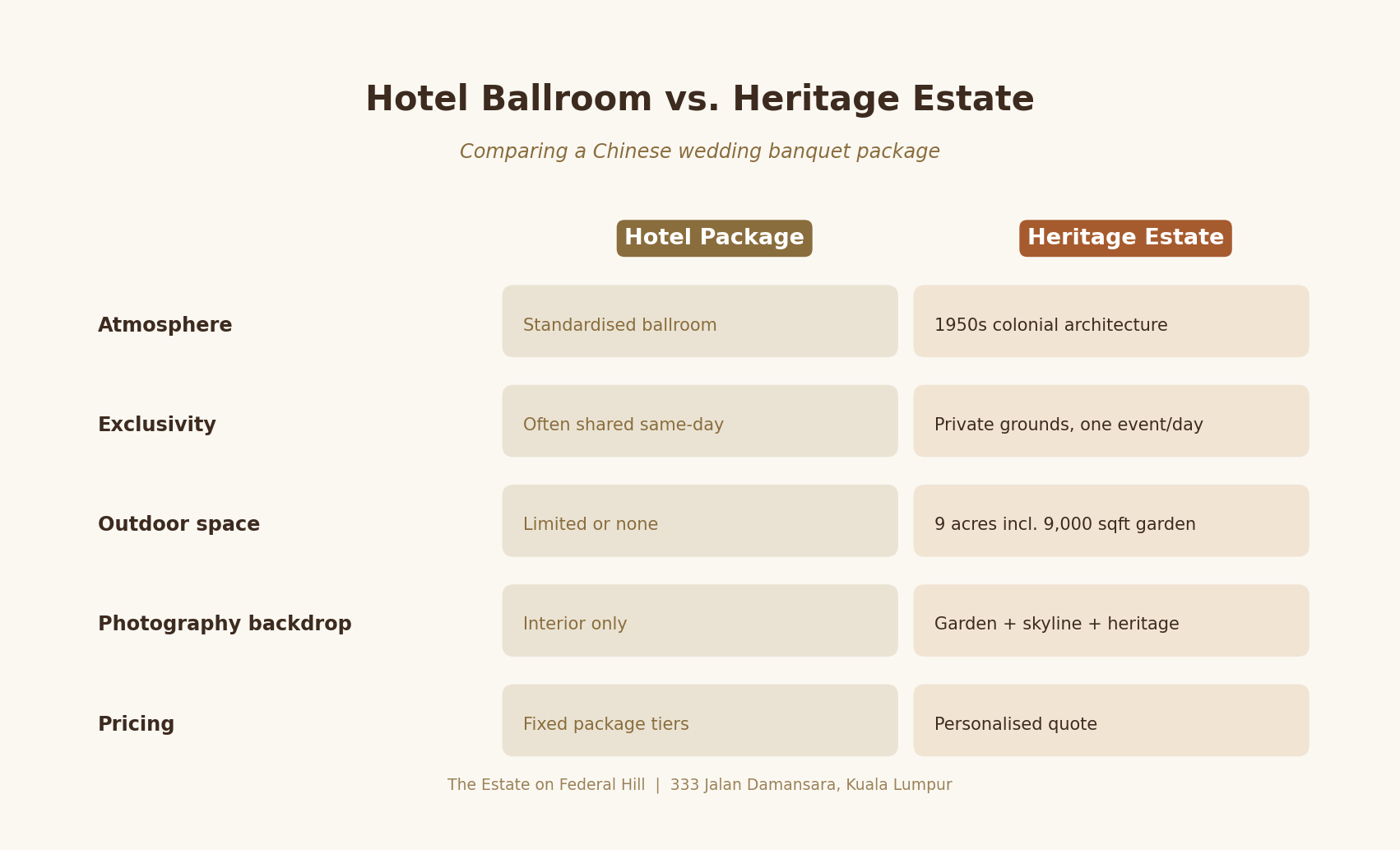
Search results for a Chinese wedding venue in Kuala Lumpur are dominated almost entirely by two categories: hotel Chinese Wedding Packages and restaurant banquet halls. Both are competent, well-practiced options hotels in particular have refined the mechanics of a large seated banquet but they share a limitation. A hotel ballroom looks, by design, largely the same regardless of which couple is using it that weekend. The chandeliers, the carpet, the stage backdrop these are fixed elements meant to suit any event, not a specific couple's wedding.
A heritage estate offers a genuinely different starting point. The Estate on Federal Hill sits on 9 acres of tropical rainforest plantation land, giving a Chinese wedding banquet a garden setting that no hotel ballroom in Kuala Lumpur can replicate because the garden isn't a design choice, it's the actual grounds the property was built on. The main house itself was built in 1950 and carries genuine colonial-era architectural detail, rather than the more generic "heritage-style" branding hotels sometimes apply to their function rooms.
The result is a wedding that moves through real, varied spaces over the course of a day garden and indoor elegance in one venue rather than one room dressed differently for each segment. For a celebration built around several distinct rituals, that variety isn't a luxury it actually suits the structure of a traditional Chinese wedding better than a single ballroom does.
This matters practically, too, not just aesthetically. A traditional Chinese wedding day is really a sequence of smaller events strung together door games, tea ceremony, photographs, cocktail hour, banquet, toasting and each of those has a different ideal scale, sound level, and mood. Trying to run all of them through one ballroom means either compressing them into a single space that suits none of them particularly well, or paying for a reconfiguration between segments that eats into the day's timeline. A property with several distinct areas built for different purposes sidesteps that trade-off entirely.
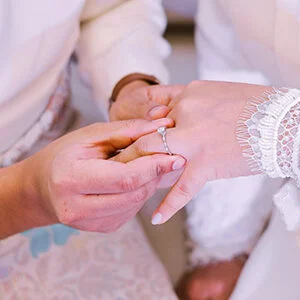
The tea ceremony is usually the most personal part of a Chinese wedding day the couple serving tea to parents, grandparents, and senior relatives, in a room quiet and dignified enough to hold the moment properly. It doesn't need a large space, but it needs the right one: somewhere that feels considered, not incidental.
For most families, the Private Room is the natural fit. At 800 sq ft and suited to 30 to 50 guests, its footprint comfortably holds an extended family tea ceremony without feeling like a repurposed meeting space stood in at the last minute. Larger extended families, or couples who want to combine the tea ceremony with an immediate small gathering afterward, may prefer the Great Hall instead, which offers considerably more room to work with at 3,100 sq ft and up to 100 guests.
Timing matters here too. Tea ceremonies are traditionally a morning ritual, often preceded by door games at the groom's point of entry which is where a property with real garden grounds has a practical advantage, giving families somewhere to stage the games before moving indoors for tea.
Many families also want the tea ceremony photographed carefully, since it's often the only point in the day where three generations are gathered in one frame. A room with genuine architectural detail cornicing, natural light through original windows, a sense of history in the walls photographs very differently to a hotel meeting room with a pop-up backdrop, and that difference tends to show clearly in the resulting wedding album.
Door games the series of challenges the groom's party must complete before being allowed in to collect the bride are traditionally boisterous, often chaotic, and need somewhere with enough room and forgiveness for a crowd of friends and family to gather without disrupting the rest of the day's proceedings. Garden grounds handle this naturally in a way an interior lobby or hotel corridor cannot.
Once the wedding transitions into its reception phase, that same outdoor space extends into a cocktail reception before guests move indoors for the banquet. The Hilltop Garden spans 9,000 sq ft and accommodates 150 to 350 guests, giving a Chinese wedding cocktail reception genuine room to breathe rather than the tight, roped-off garden terraces some hotels offer as an afterthought to their ballrooms. For a debate between formats, our piece on choosing between a wedding hall and a garden venue is a useful companion read though at a property with both, the choice isn't really either/or.
There's a photography dividend here too. A garden reception timed toward late afternoon captures golden-hour light against Kuala Lumpur's skyline a backdrop that simply isn't available inside a hotel function room, however well-lit.
The seated banquet typically eight to ten courses, punctuated by toasting rounds as the couple moves table to table is the anchor of a Chinese wedding day, and it's where scale matters most. Hotel ballrooms are built to flex up toward very large numbers, which works for sizeable weddings but can feel cavernous and impersonal for couples hosting a more intimate guest list.
The Great Hall, at 3,100 sq ft and seating 50 to 100 guests, suits couples who want a proper multi-course banquet and toasting ritual without the scale or the noise of a 30-table hotel ballroom built for several hundred. It's sized for a banquet that still feels like a gathering of people who know each other, rather than a hall of strangers organised into round tables.
Because the venue handles full event logistics in-house AV support for toasts and speeches, catering coordination timed to a multi-course banquet, and decoration that works with, rather than against, the room's existing architecture couples aren't left assembling vendors independently the way they sometimes are with a bare rental hall.
Toasting rounds, where the couple moves from table to table with the groom's party, tend to work better in a room where guests can see the couple's progress around the space rather than losing them behind pillars or a raised stage something worth walking through in person with an events coordinator before finalising a table layout. Since the Great Hall's proportions are fixed and known in advance, this kind of table-and-flow planning can be mapped out well ahead of the wedding day rather than improvised on-site.
Comparing a Heritage Estate to a Hotel Chinese Wedding Package
The decision between a hotel package and a private heritage estate usually comes down to a handful of practical differences:
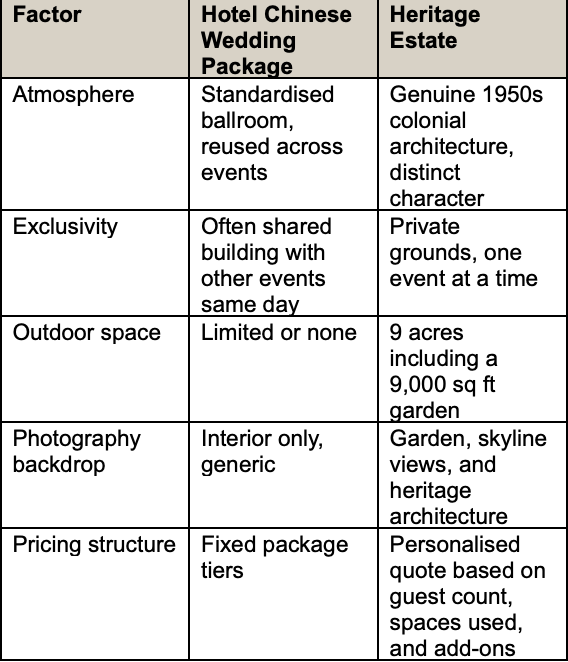
That last row is worth being direct about: unlike hotel packages with published tiers, a heritage estate booking is quoted individually, based on which spaces you use, your guest count, the season, and any catering, AV, or decoration add-ons. That's a deliberate approach rather than a gap every Chinese wedding banquet here is different enough in scale and configuration that a fixed package wouldn't actually serve most couples well. The most reliable way to get real numbers is to request a personalised quote directly.
Couples weighing a Chinese wedding against other multi-part traditions may also find it useful to see how an Indian wedding celebration uses the same grounds across multiple days and ceremonies the underlying flexibility is the same, just applied to a different set of rituals. And if you want a fuller sense of how an entire wedding day actually unfolds at the property, hour by hour, our wedding day walkthrough covers that in detail.
What is included in a traditional Chinese wedding tea ceremony?
A traditional tea ceremony involves the couple formally serving tea to parents, grandparents, and senior relatives from both families, usually in order of seniority, as a gesture of respect and gratitude. It's typically held in a quiet indoor room close family and elders can gather in comfortably, often in the morning before the wider reception begins.
Can a Chinese wedding banquet be held outdoors in Malaysia?
The tea ceremony and formal banquet are usually held indoors given their structured, seated nature, but the reception, door games, and cocktail portions of a Chinese wedding day work well outdoors in Malaysia's climate. A venue with both garden grounds and an indoor hall allows a couple to split the day naturally between the two rather than forcing every segment into one room.
How many tables/guests can a heritage hall accommodate for a Chinese banquet?
The Great Hall spans 3,100 sq ft and comfortably seats 50 to 100 guests for a banquet, which typically works out to roughly six to twelve banquet tables depending on table size and layout. Couples wanting a larger reception before or after the banquet can extend into the Hilltop Garden, which holds 150 to 350 guests.
What's the difference between a hotel Chinese wedding package and a private estate venue?
A hotel package offers a standardised ballroom and fixed pricing tiers, usually shared with other events in the same building on the same day. A private heritage estate offers exclusive use of the grounds for the day, genuine architectural character rather than a generic function room, real outdoor garden space, and pricing built around a personalised quote rather than a fixed package.
Plan Your Chinese Wedding Banquet
Seeing how the tea ceremony room, the garden, and the Great Hall connect to each other is much easier in person than in photographs. Book a site visit to walk the full flow of a Chinese wedding day at 333 Jalan Damansara on Federal Hill, Bangsar, and picture your own tea ceremony, reception, and banquet across the estate's spaces. Call or WhatsApp 011-20867268, or email hello@whitehouse.estate, to arrange a tour.