
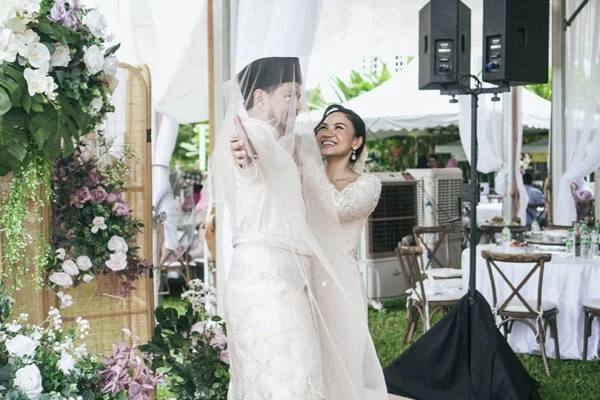
A traditional Malay wedding day at The Estate typically unfolds in two ceremonial halves within the same grounds: a morning akad nikah, or solemnisation, followed later by the bersanding — the ceremony in which the couple is formally "enthroned" before their guests. Both can happen on the same property, on the same day, without a single relocation between venues.
Anyone researching bersanding traditions online tends to land in one of two places: cultural explainer sites that describe the ceremony's meaning in detail but say nothing about where or how it's actually staged, or venue marketing pages that show a room but skip the cultural context entirely. Neither answers the question a couple actually has, which is what the whole day looks like, space by space, from the moment preparations begin to the last dance of the evening.
This is a composite walkthrough — not one specific couple's story, but a realistic account of how a full Malay wedding day is typically structured across the venue's four spaces. It follows the same "what actually happens" format as the estate's general wedding-day case study, applied specifically to a traditional bersanding celebration.
A full Malay wedding day is rarely a single ceremony. It is typically built around two distinct events: the akad nikah, the religious solemnisation that legally and spiritually binds the couple, and the bersanding, the cultural "sitting in state" ceremony where the newlyweds are presented to family and friends on a decorated dais. Some couples hold both on the same day; others separate them by weeks. Either structure works at a venue built to accommodate both.
The Estate's four spaces span from an 800 sq ft Private Room to a 9,000 sq ft Hilltop Garden, which is precisely what allows a couple to move from an intimate morning solemnisation to a large-scale evening reception without ever leaving the property. That continuity matters more than it might seem — for a multi-generational family, keeping the whole day on one 9-acre site removes the logistics of shuttling elderly relatives or vendors between locations.
It's worth being direct about scope here: this article focuses on the bersanding and reception side of the day. Ceremony-specific logistics for the akad nikah itself — documentation, the role of the wali and saksi, the solemnisation procedure — are already covered in detail in the venue's Nikkah ceremony checklist, so this piece won't duplicate that ground.
The morning of a traditional Malay wedding day is usually reserved for two things: the solemnisation itself, if it's happening the same day, and bridal or groom preparation — hair, makeup, and dressing in preparation for the bersanding later on.
For an intimate akad nikah or as a dedicated getting-ready space, the Private Room's 800 sq ft footprint, built for 30 to 50 guests, suits the scale of a morning that typically involves close family rather than the full guest list. It offers a contained, quieter space before the day opens up to a larger crowd in the afternoon or evening.
Because the specific procedural steps of an akad nikah — the paperwork, the presence of a wali and saksi (witnesses), and the solemnisation sequence itself — are already covered thoroughly elsewhere on the site, this walkthrough moves straight from morning preparation into the ceremony that defines the rest of the day: the bersanding.
Bersanding is the heart of a traditional Malay wedding's cultural program. The word itself means "sitting side by side," and the ceremony involves the couple being formally seated together on a decorated pelamin — a raised dais — while guests observe, offer blessings, and mark the couple's new status as husband and wife.
Staging a bersanding well depends heavily on room proportions, sightlines, and the size of the guest list. The Great Hall, at 3,100 sq ft and built for 50 to 100 guests, works well for a bersanding with a moderate-sized crowd where the dais needs to be a clear focal point in a formal indoor setting. For larger extended-family gatherings, the Hilltop Garden's 9,000 sq ft footprint, accommodating 150 to 350 guests, gives a pelamin room to be a genuine centrepiece rather than a crowded corner.
The specifics of dais design, staging considerations, and how bersanding logistics map onto each of the venue's spaces are explored in far more depth in the venue's dedicated Malay wedding venue guide — worth reading alongside this piece if you're planning the ceremony itself rather than picturing the day as a whole.
A bersanding ceremony is rarely a silent affair. Traditional performances — silat demonstrations, processional music, or cultural dance — commonly accompany the couple's arrival at the dais, turning the walk to the pelamin into a moment of its own rather than a formality.
Hosting a performance well requires space that scales with the guest list, and this is where the choice of venue genuinely matters. A 9,000 sq ft garden can comfortably hold a procession route, a performance area, and guest seating for up to 350 people at once — a scale that matters for Malay weddings, which often involve large extended-family guest lists spanning multiple generations. Full event logistics, including AV support for music and announcements, decoration coordination for the dais and procession route, and catering timed around the ceremony, are handled as part of the venue's broader private-estate wedding offering.
The result is a ceremony that feels choreographed rather than improvised — guests know where to stand, the couple's procession has a clear path, and the performance has room to actually be seen rather than glimpsed over shoulders.
As the ceremonial elements of the day wind down, the tone typically shifts toward the reception — dinner service, toasts from family, and the more relaxed celebration that closes out a long day.
For this closing chapter, the venue's spaces again offer a choice depending on mood: the Sky Balcony, at 1,715 sq ft and built for 70 to 100 guests, offers an open-air evening setting with a panoramic KL skyline as the backdrop, well suited to a smaller reception with a lounge-like atmosphere, while the Hilltop Garden remains the natural choice for a larger dinner reception continuing directly from the bersanding.
This overall arc — morning preparation, midday ceremony, evening reception — mirrors the structure documented in the estate's general wedding-day case study, simply built around Malay cultural tradition rather than a generic format. For couples weighing how their own tradition fits the venue, the multicultural weddings FAQ maps out how each of the site's spaces suits different ceremonial traditions side by side.
Bersanding is the ceremony in which a newly married couple is formally seated together on a decorated dais, or pelamin, before family and guests. It typically follows the akad nikah and is often accompanied by traditional performances, blessings from elders, and a procession to the dais.
A full day combining a morning akad nikah, a bersanding ceremony, and an evening reception typically spans most of a day, though the exact schedule depends on the couple's chosen structure. Some couples hold the solemnisation on a separate day and dedicate the full event day to the bersanding and reception.
Yes. The Estate's spaces — from the 800 sq ft Private Room to the 9,000 sq ft Hilltop Garden — allow a morning solemnisation and an evening bersanding reception to take place on the same 9-acre property without relocating between venues.
While specific menus are arranged directly with the venue's catering coordination team, a Malay wedding reception typically centres on a full sit-down or buffet-style meal served as part of the evening celebration, coordinated through the venue's state-of-the-art kitchen facilities as part of full event logistics.
---
Picturing your own bersanding celebration across these spaces? Book a site visit to walk the Great Hall, Hilltop Garden, Sky Balcony, and Private Room in person, and see how a morning solemnisation can flow into an evening reception on the same grounds. The Estate on Federal Hill is located at 333 Jalan Damansara, Kuala Lumpur, in the Bangsar area — a heritage setting for a day rooted in tradition.