
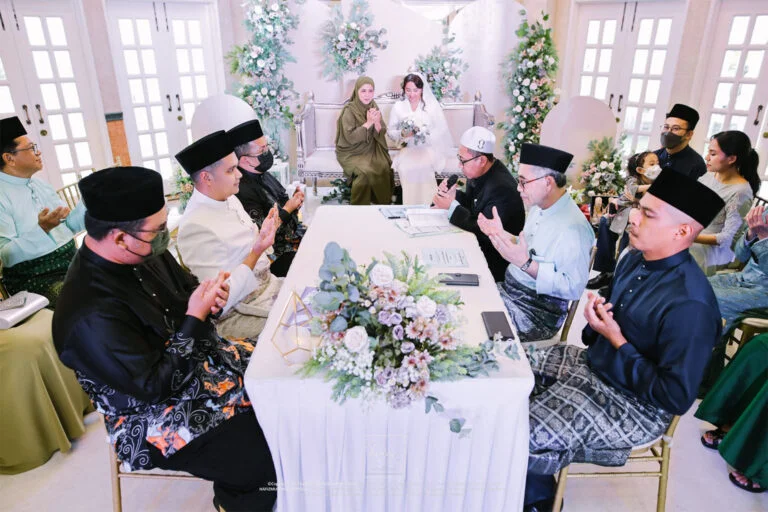
An akad nikah in Kuala Lumpur legally and spiritually requires just five elements: the bride, the groom, a wali (or an appointed wakil), two Muslim witnesses, and a JAWI-registered solemniser. Paperwork must be lodged with the Islamic Religious Department ahead of the date, and the ceremony itself is often complete within fifteen to twenty minutes. Everything else the venue, the guests, the reception that may follow is a matter of planning, not requirement.
That distinction is worth sitting with, because most searches for "nikkah ceremony" come from couples who already understand the basic meaning and are now trying to plan the actual day: what paperwork needs to be filed, who has to be in the room, how many guests can realistically attend, and which spaces in a venue actually suit a ceremony this intimate. This guide is built as a checklist for exactly that stage of planning.
We've written about the meaning and background of the akad nikah in detail on our nikah ceremony guide, which remains the right starting point if you want the fuller cultural and religious context. This article picks up where that one leaves off it's the step-by-step companion for couples who are past the "what is nikah" stage and into the "how do we actually do this" stage.
A common source of confusion even among couples raised in the tradition is the difference between the nikah itself and the civil registration that surrounds it. The akad nikah is the Islamic solemnisation contract: a spoken declaration and acceptance (ijab and qabul) exchanged between the groom and the wali or his representative, witnessed and validated according to Islamic law. It is a religious and legal act in its own right. The paperwork trail with JAWI the application, the counselling course for first-time couples, the registration certificate exists to formalise that act within Malaysia's dual legal system, but it is administrative scaffolding around the ceremony, not the ceremony.
This matters for planning because it means the akad nikah does not require a large production to be complete. An akad nikah ceremony can be legally and spiritually finished in a room built for as few as 30 guests, since Islamic law asks only for the couple, the wali, two witnesses, and the solemniser to be present. Everyone else in the room parents, siblings, close friends is there by invitation, not requirement. That's an important thing to know before you start planning guest numbers, because it means the ceremony can be as intimate or as expansive as a family wants it to be.
"Solemnization in Islam" is simply the more formal English rendering of what happens at an akad nikah the two terms describe the same act. If you're comparing venues or vendors and one refers to "Islamic solemnisation services" and another to "akad nikah," they are talking about the same ceremony.
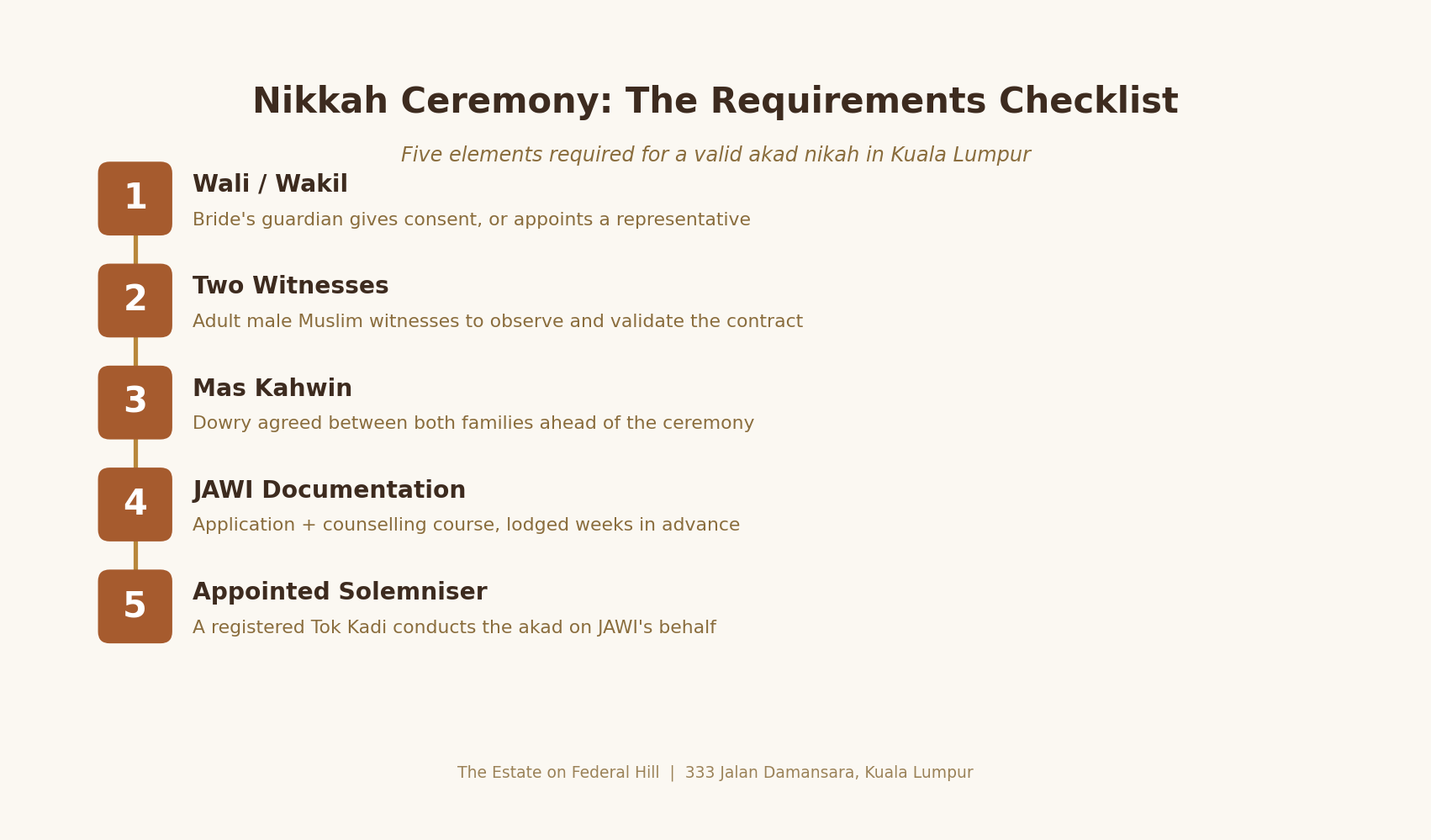
Before booking a date or a room, it helps to have the requirements laid out plainly. Here is what a couple in Kuala Lumpur typically needs to have in place:
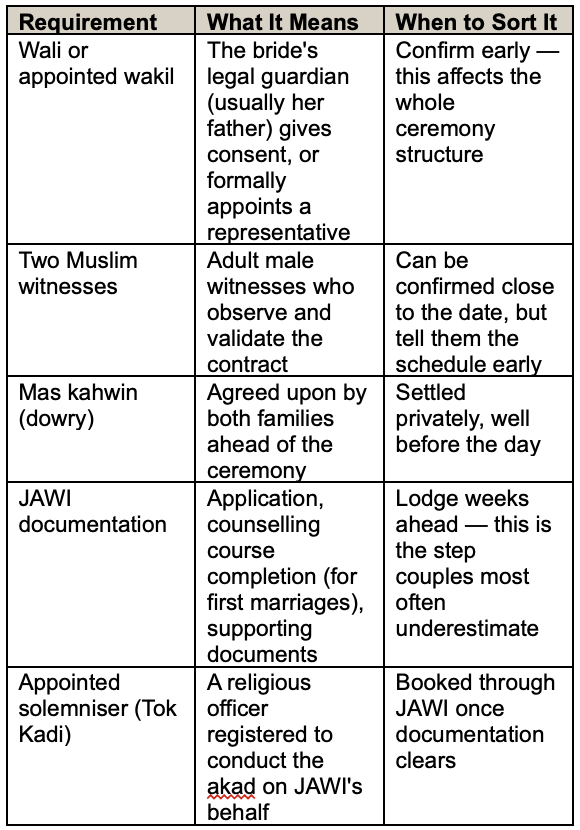
Malaysia's Islamic authorities generally require nikah paperwork to be lodged with JAWI several weeks before the intended ceremony date, which means venue booking and paperwork should run in parallel rather than one after the other. A common mistake is waiting for JAWI approval before locking in a venue date in practice, it's safer to hold a provisional venue date while the paperwork moves through its own timeline, then confirm both once the solemniser is assigned.
Because the ceremony itself involves only a handful of required participants, the right room is less about square footage and more about atmosphere a space that feels quiet, dignified, and appropriately scaled to however many guests a family chooses to invite.
For families keeping the akad nikah genuinely small immediate family, the wali, witnesses, and the solemniser the Private Room, at 800 sq ft and suited to 30 to 50 guests, offers a self-contained setting away from the rest of the estate. It's proportioned for a ceremony, not a banquet, which tends to suit the quieter register that many families want for this specific moment.
For couples combining the akad nikah with a larger gathering immediately after a doa selamat, a small bersanding, or a modest reception for extended family the Great Hall is often the better fit. The Great Hall spans 3,100 sq ft and seats 50 to 100 guests, which gives a couple enough room to hold the solemnisation at one end and transition guests into a seated or standing gathering without needing to relocate everyone to a second venue. Both rooms sit within the same heritage estate, so the colonial-era architecture and garden views carry through whichever space is chosen you're not trading atmosphere for practicality either way.
A typical akad nikah day, once the venue and paperwork are settled, follows a fairly consistent sequence:
1. Arrival and setup — the couple, wali, witnesses, and solemniser arrive; the room is arranged with seating for the required parties and any invited guests.
2. Check-in with the solemniser — the Tok Kadi confirms documentation and briefs the wali and witnesses on the process.
3. The akad itself — the ijab and qabul exchange, typically the shortest and most concentrated part of the day.
4. Doa selamat — a prayer of blessing, often said immediately after the contract is completed.
5. Photographs and well-wishes — family and guests come forward once the formal portion concludes.
6. Transition (if applicable) — guests move into a reception, meal, or gathering in an adjoining or the same space.
For ceremonies where guests will pray on-site before or after the akad it's worth confirming prayer space and timing with the venue in advance, along with catering arrangements for anyone staying on afterward. This is where working with a venue that manages full event logistics in-house parking, AV equipment for Quranic recitation or readings, decoration, and catering coordination removes a layer of coordination that would otherwise fall on the family.
Once the akad nikah is complete, many families move into hantaran and gift exchange a customary presentation of gifts between the two families that often happens the same day or shortly after. Guest counts for this part can expand well beyond the ceremony's required minimum, since hantaran and well-wishing tend to draw in extended family and friends who weren't part of the formal solemnisation itself.
If you're still deciding what to give a newly married couple whether as a guest or as part of hantaran planning our guide to wedding gift ideas for newlyweds in Malaysia covers options that suit both traditional and modern preferences.
Beyond the ceremony day itself, couples planning a full wedding around their akad nikah often want to understand how a genuinely historic setting shapes the rest of the celebration from decor choices to photography backdrops. Our styling guide to the estate's colonial architecture is a useful next read if you're building out the bigger picture beyond the solemnisation itself. And if pricing, capacity, and booking logistics are still open questions, our booking FAQ hub answers the practical questions couples ask most.
FAQ
What is required for nikah?
An akad nikah requires the bride, the groom, the bride's wali (guardian) or an appointed wakil, two Muslim witnesses, and a JAWI-registered solemniser. Documentation must be lodged with JAWI in advance, and mas kahwin is agreed between families before the ceremony. Everything beyond these elements venue, guest count, reception is a matter of family preference, not religious requirement.
What is the difference between nikah and marriage?
Nikah refers specifically to the Islamic solemnisation contract the spoken exchange between the groom and the wali, witnessed and validated under Islamic law. "Marriage" in the broader Malaysian legal sense includes the civil registration process with JAWI that formalises the nikah within the national legal system. The nikah is the religious act; registration is the administrative process around it.
Is solemnization in Islam the same as akad nikah?
Yes. "Solemnization in Islam" is simply the English-language term for what happens during an akad nikah the two describe the same ceremony. You may see venues or vendors use either term interchangeably.
How many guests can attend an akad nikah at a private venue?
Islamic law only requires the couple, wali, two witnesses, and the solemniser to be present, so guest numbers are entirely up to the family. At a heritage estate, a Private Room suited to 30 to 50 guests works well for an intimate, family-only akad nikah, while the Great Hall, seating 50 to 100, suits families combining the solemnisation with a larger gathering immediately after.
Can indoor and outdoor nikah ceremonies both be held at a heritage venue?
Yes, though most families choose an indoor room for the akad nikah itself, given its formal and intimate nature, and reserve outdoor garden spaces for a related reception or photography session afterward. A heritage estate with both indoor rooms and garden grounds allows a couple to hold the solemnisation indoors and move outdoors for photographs or a subsequent gathering without changing venues.
Ready to Plan Your Akad Nikah?
The right room for a solemnisation is hard to judge from photographs alone — the scale, the light, and the quiet of a space matter more here than almost any other part of a wedding. If you're planning an akad nikah in Kuala Lumpur, book a site visit to walk through the Private Room and the Great Hall in person at 333 Jalan Damansara, on Federal Hill in Bangsar, and see which setting feels right for your family's ceremony. Reach out via WhatsApp at 011-20867268 or email hello@whitehouse.estate to arrange a tour.