
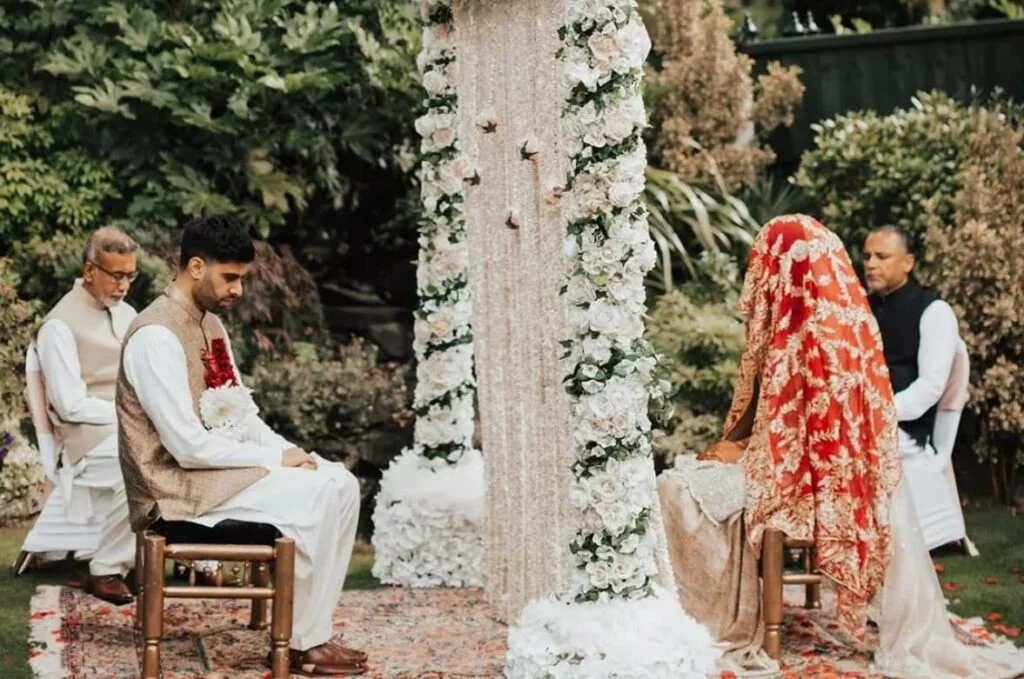
A traditional Indian wedding in Kuala Lumpur is rarely a single event. Most families plan across three to four distinct occasions a mehndi evening, a sangeet, the main ceremony (often centred on a mandap and, for Hindu weddings, a fire ritual), and a reception and the celebration works best when each occasion has a space suited to its own scale and mood, rather than one ballroom reused and redecorated for every stage.
That's the central planning challenge for couples researching Indian wedding venues in Kuala Lumpur, and it's one that most search results don't actually address. Hotel wedding packages are built around a single ballroom booking; they can be adapted for a multi-day event, but they weren't designed with one in mind. A property with genuinely distinct indoor and outdoor spaces a garden large enough for a mandap and its guests, smaller rooms suited to an intimate sangeet, and a grand hall for the reception banquet solves this more naturally.
This article walks through how each stage of a multi-day Indian wedding maps onto a heritage estate's actual spaces, from the outdoor mandap ceremony through to the final reception banquet.
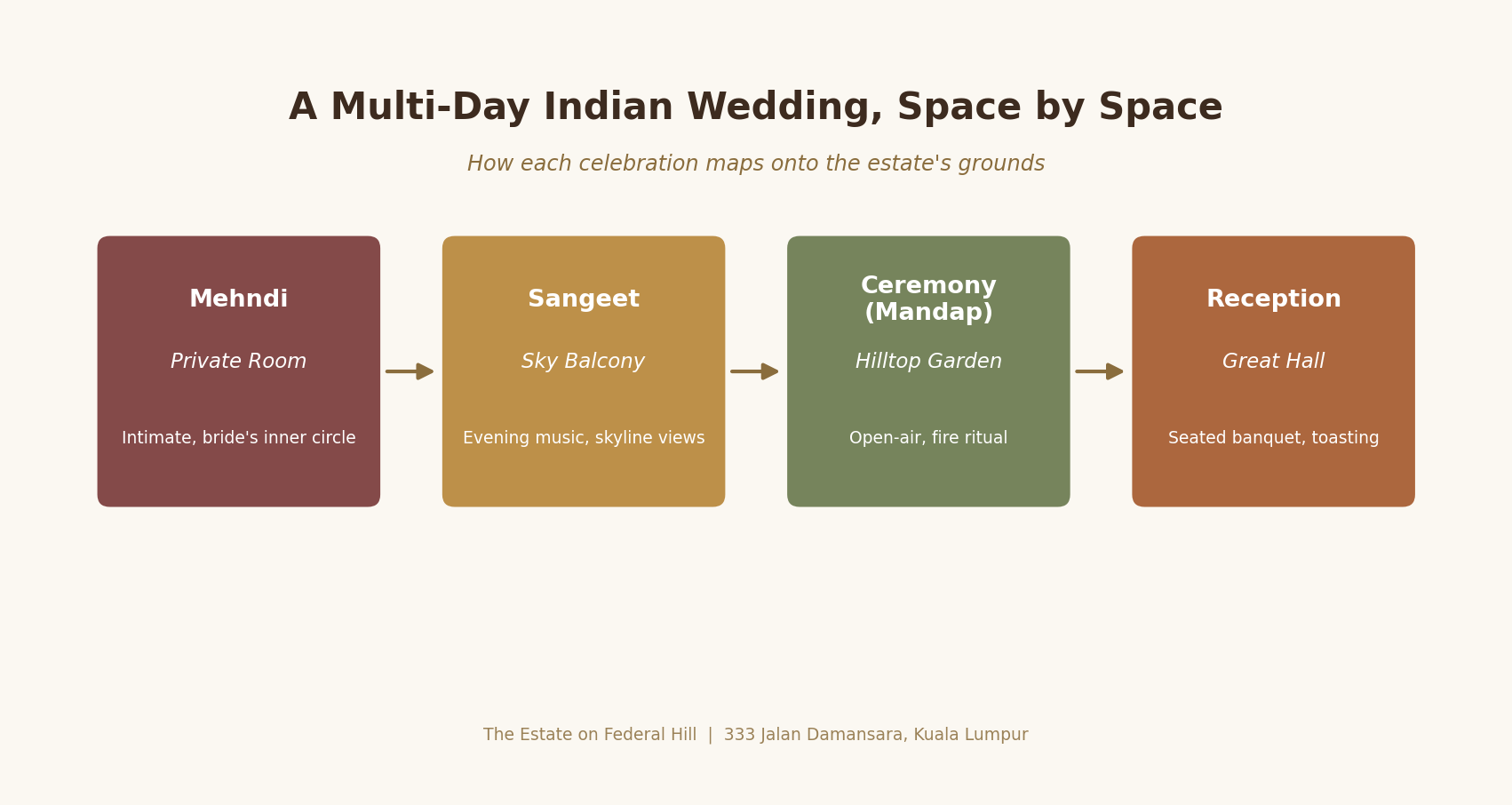
The shape of an Indian wedding celebration varies by community and family, but a common arc runs across several days: a mehndi evening for the bride's henna application, usually intimate and female-led; a sangeet, a livelier evening of music, dance, and performances from both families; the main ceremony itself, which for Hindu weddings is typically centred on a mandap and includes the agni (sacred fire) ritual, and for Sikh weddings centres on the Anand Karaj at a gurdwara before moving to a celebratory reception; and finally the reception, a larger banquet for extended family, friends, and community.
Hosting all stages of a multi-day Indian wedding at one property removes a considerable amount of logistical strain décor doesn't need to be broken down and rebuilt at a new location each day, caterers and vendors gain familiarity with the space after the first event, and guests, especially those travelling from out of town, only need to learn one route. This is one of the clearest practical advantages a single heritage estate with multiple distinct spaces has over stitching together several separate venues across a city.
It's worth noting, too, that Hindu and Sikh wedding traditions differ meaningfully in structure the fire ritual central to a Hindu ceremony has no equivalent in a Sikh Anand Karaj, for instance and a venue that can flex between an open-air ceremonial setup and a simpler reception-only booking is better positioned to serve either tradition without forcing a one-size-fits-all format.
Traditionally, the mandap the four-pillared canopy under which the couple sits for the core of a Hindu wedding ceremony is an open-air structure, historically set up outdoors so the fire ritual could be conducted beneath open sky. Recreating that inside a sealed hotel ballroom, however well decorated, loses something of the original intent. An actual garden setting honours that tradition far more directly than an indoor substitute.
The Hilltop Garden spans 9,000 sq ft and holds 150 to 350 guests, giving a mandap ceremony and its surrounding guest seating genuine room to be staged without the setup feeling cramped or the backdrop feeling artificial. At that scale, there's space for the mandap structure itself, guest seating arranged with clear sightlines, and the processional entrance (baraat, for Hindu ceremonies, or the groom's party arrival more generally) that many families want to include as part of the day.
For the agni or fire ritual specifically, outdoor staging also simplifies practical safety considerations ventilation, sightlines for family gathered close to the fire, and coordination with venue staff on placement are all more straightforward in open air than inside an enclosed room. Couples planning this ritual should raise it early with their venue coordinator so the layout can be planned around it from the start, rather than adapted at the last minute.
Mehndi and sangeet events are typically more casual and more intimate than the main ceremony mehndi in particular is often a daytime or early-evening gathering centred on the bride's inner circle, while sangeet tends to be a livelier evening affair with music and performances, but still usually smaller than the full wedding guest list.
For these scaled-down events, the Sky Balcony is often a strong fit. It offers 1,715 sq ft for up to 100 guests, an elevated outdoor setting well suited to an evening sangeet, with music, string lighting, and skyline views over Kuala Lumpur adding atmosphere without requiring the scale of the Hilltop Garden. Families hosting a smaller, more private mehndi gathering may prefer the Private Room instead, which keeps the event contained and unhurried.
Booking multiple spaces across consecutive days at one property also simplifies scheduling considerably vendors, decorators, and family coordinators are working within one property's calendar rather than juggling separate contracts, load-in times, and access windows at different venues across the city. Couples weighing an outdoor-first approach more broadly may find our piece on garden weddings in Malaysia useful for the practical realities of planning around weather, timing, and outdoor logistics.
Once the ceremony concludes, most Indian weddings move into a reception typically the largest single gathering of the celebration, drawing extended family, friends, and community members who may not have attended the more intimate mehndi or sangeet events.
Couples have real flexibility here depending on the scale they want. For a seated banquet following an outdoor ceremony, the Great Hall offers 3,100 sq ft and seats 50 to 100 guests well suited to a formal multi-course reception with speeches and toasting. For a larger celebration, the Hilltop Garden's capacity of up to 350 guests allows the reception to remain outdoors, continuing directly from the ceremony without a full relocation.
Combining the Hilltop Garden's 350-guest capacity for the ceremony with the Great Hall for a more intimate banquet afterward lets a couple scale each part of the day to its true audience, rather than forcing one room to accommodate both a large ceremony crowd and a more contained reception dinner. Catering coordination for Indian cuisine vendors, AV support for speeches and music, and decoration that works with the mandap and reception setup are handled by the venue's events team as part of full event logistics one less set of vendor relationships for a family to manage independently across a multi-day event.
Booking a venue across several consecutive days introduces coordination questions that a single-event booking doesn't: vendor load-in and load-out schedules between events, guest transportation and parking across multiple days, and for families hosting out-of-town or overseas guests proximity to accommodation.
For couples flying guests in from outside Malaysia, whether for a mehndi-to-reception arc or a full destination wedding built around the celebration, our guide to planning a destination wedding in Malaysia covers the logistics that matter most for visiting family and friends. And because multi-day, multi-ceremony bookings involve more moving parts than a single-day event, they generally need to be handled through formal, direct coordination rather than a quick inquiry which is why a detailed request, rather than a phone call, tends to get couples the clearest answers on scheduling and space availability.
Couples comparing how other traditions handle a similarly ritual-dense wedding day may find it useful to see how a Chinese wedding banquet maps its own ceremonies onto the same estate's spaces the underlying principle of matching ritual to room applies across traditions. And for families who want their mandap or reception styled in a way that complements rather than competes with the property's genuine 1950s architecture, our colonial architecture styling guide is a helpful next step.
Can a mandap ceremony be held outdoors in KL?
Yes, and an outdoor setting is closer to the mandap's traditional open-air design than an indoor ballroom. A garden space large enough to hold the mandap structure, guest seating, and a processional entrance such as a 9,000 sq ft garden accommodating 150 to 350 guests allows the ceremony to be staged the way it was traditionally intended, with the fire ritual conducted under open sky.
How many days does a typical Indian wedding celebration take?
Most Indian weddings in Kuala Lumpur run across three to four distinct events: mehndi, sangeet, the main ceremony, and the reception, often spread over two to four days depending on family tradition and scale. Hosting all of these at one property with multiple distinct spaces simplifies logistics considerably compared to booking separate venues for each event.
Does the venue accommodate both Hindu and Sikh wedding traditions?
Yes. The venue's mix of outdoor garden space and indoor halls can flex to suit a Hindu ceremony centred on a mandap and fire ritual, or a reception-focused celebration following a Sikh Anand Karaj held at a gurdwara. Because each tradition has different spatial and ritual requirements, it's best to discuss your specific ceremony structure directly with the venue's events team when planning.
What's the guest capacity for an Indian wedding reception?
Reception capacity depends on which space is used: the Great Hall seats 50 to 100 guests for a formal seated banquet, while the Hilltop Garden accommodates 150 to 350 guests for a larger outdoor reception. Many couples use the Hilltop Garden for the ceremony and a larger guest count, then move into the Great Hall for a more intimate banquet afterward.
Start Planning Your Multi-Day Celebration
A wedding built across several days and several ceremonies deserves a venue team that can coordinate the whole arc, not just a single booking. Send a request through our inquiry form with your ceremony structure, expected guest counts, and preferred dates, and our team will help map your mehndi, sangeet, ceremony, and reception across the estate's spaces at 333 Jalan Damansara, Federal Hill, Bangsar. You can also reach us directly at hello@whitehouse.estate or 011-20867268 to start the conversation.