
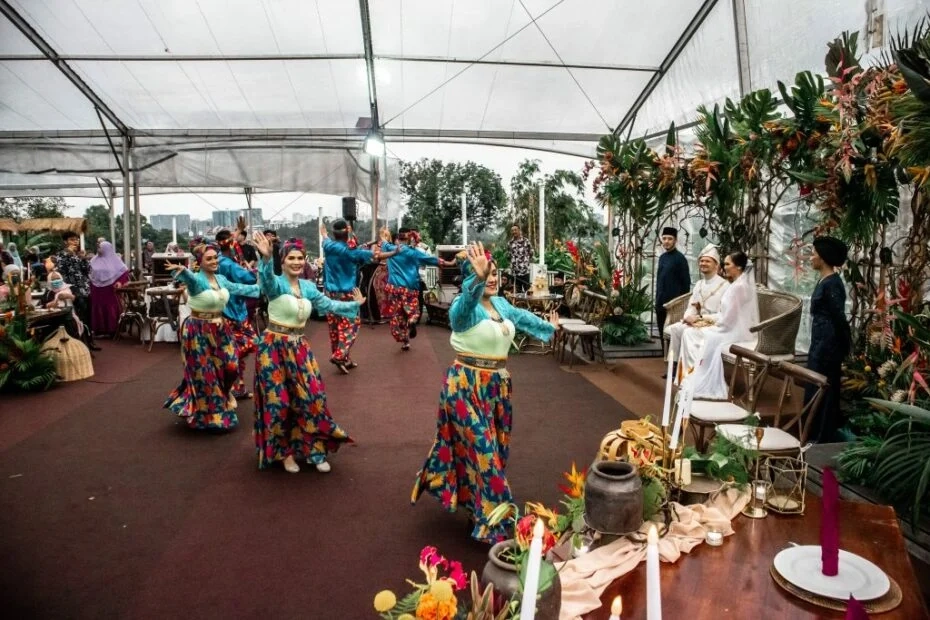
The best Malay wedding venues in Kuala Lumpur for a bersanding reception are not generic hotel ballrooms wrapped in a rented "Malay Flair" package for the day. They are properties with genuine architectural weight — real ceilings, real grounds, real history — that can hold a pelamin, a procession, and a few hundred guests without borrowing their character from banquet drapery. The Estate on Federal Hill is one of the few properties in Kuala Lumpur built for exactly that: a colonial-era residence on 9 acres of hilltop grounds in Bangsar, with spaces ranging from the intimate 800 sq ft Private Room to the 9,000 sq ft Hilltop Garden.
Couples searching for a Malay wedding venue in KL tend to land in one of two disappointing lanes. The first is the hotel ballroom, where "Malay wedding package" usually means a generic function room with a rented pelamin backdrop and a buffet line — the same room used for a corporate dinner the night before and a product launch the week after. The second is the open-air marquee, which offers grounds but little of the shelter, staging infrastructure, or backup plan a bersanding deserves if the weather turns. Neither lane addresses what a bersanding actually needs spatially: a dais with presence, a procession route guests can move through with dignity, and enough flexible space to host performances, dining, and photography without constant reconfiguration.
This is where a heritage estate changes the equation. A bersanding held on a hilltop property built in 1950, with the Kuala Lumpur skyline behind the dais and 70-plus years of history in the walls, carries a different kind of gravity than a function room with a false ceiling and hotel carpet. This article focuses specifically on the bersanding and reception side of a Malay wedding — the dais staging, the traditional performances, the guest hosting — rather than the akad nikah ceremony itself, which is covered in detail in the site's existing Nikkah ceremony checklist. Here's how the two halves of the day, and the specific spaces that support them, actually fit together.
Bersanding is the enthronement ceremony at the heart of a Malay wedding reception: the bride and groom are seated together on a raised pelamin, dressed in matching or complementary traditional attire, while family and guests process past to offer blessings — in some regions accompanied by bertepung tawar or berbedak, the ritual dabbing of scented rice flour. It is a public, processional moment, which means the room around it matters as much as the dais itself. A pelamin crammed into a corner of an overbooked ballroom loses the sense of occasion the ceremony is built for.
A space needs three things to host bersanding well: a clear sightline to the dais from most of the seating, enough floor width for a procession to move without guests having to stand and shuffle chairs, and a backdrop that doesn't compete visually with the couple. The Estate's Great Hall answers all three at once — at 3,100 sq ft and built to comfortably seat 50 to 100 guests, it is sized precisely for a formal dais, a procession aisle, and tiered guest seating without the room feeling either cavernous or cramped, which is the exact balance most hotel function rooms miss when they're either too large (corporate ballrooms) or too small (repurposed meeting rooms).
Because ceremony-day logistics — timing the akad nikah, seating for the solemnisation, documentation requirements — are a distinct planning track from the bersanding reception itself, this article deliberately doesn't re-cover that ground. Couples planning the morning solemnisation should work from the site's existing Nikkah ceremony checklist, which walks through the akad nikah step by step. What follows here is entirely about what happens after — the bersanding, the performances, and the reception that carries the rest of the day.
Not every Malay wedding reception is the same size, and the venue's four distinct spaces are built to match different guest counts rather than forcing every couple into one configuration.
• The Great Hall (3,100 sq ft, 50-100 pax) suits an indoor, air-conditioned bersanding where the dais sits against a formal architectural backdrop — a strong option for couples who want climate control and a controlled acoustic environment for speeches and performances, regardless of Kuala Lumpur's weather that day.
• The Hilltop Garden (9,000 sq ft, 150-350 pax) is built for a large, open-air reception where the pelamin becomes the literal centerpiece of the grounds, framed by the property's tropical landscaping rather than a ceiling.
• The Private Room (800 sq ft, 30-50 pax) works for an intimate bersanding limited to close family — a scale most hotel ballrooms simply can't offer without the room feeling absurdly oversized for the guest count.
• The Sky Balcony (1,715 sq ft, 70-100 pax) offers a middle path: a semi-outdoor bersanding with a Kuala Lumpur skyline backdrop, suited to couples who want the atmosphere of an outdoor ceremony with more architectural framing than an open lawn provides.
Matching dais placement to room scale sounds like a small detail, but it's the difference between a bersanding that reads as the day's centerpiece and one that gets visually swallowed by an oversized hotel ballroom rented at a discount because it was available.
A full Malay wedding reception rarely stays in one place. Silat demonstrations, traditional music, and cultural performances need open floor space that's distinct from the dining and dais areas — trying to run a performance in the same footprint as a seated dinner means constantly reconfiguring furniture mid-event, which most single-room hotel ballrooms simply cannot avoid.
At 9,000 sq ft, the Hilltop Garden solves this by allowing the reception to be zoned rather than crammed: a performance area, the bersanding dais, and guest dining can all coexist across the lawn without one bottlenecking the other. Because the wider property sits on 9 acres of grounds, there's also room for guests to move between the ceremony area, a lounge or photo zone, and the dining setup without the crowding that happens when 300 guests are funneled through a single hotel corridor.
This matters most for multi-generational guest lists, which is the norm at Malay weddings — elderly relatives, young children, and everyone in between attending the same event. Having both an indoor option (the Great Hall, air-conditioned and weather-independent) and an outdoor option (the Hilltop Garden) on the same property means a couple isn't forced to choose one environment for every guest; older relatives can retreat indoors while the reception continues outside, without anyone having to leave the venue. It's a flexibility that a single hotel ballroom, built as one undifferentiated box, structurally cannot offer — and it's part of why the rise of the private estate wedding as a category has specifically been driven by couples wanting this kind of zoned, multi-space flexibility rather than a single rented room.
Most of the content couples find when searching for a Malay wedding venue in KL is either a listicle ranking dozens of unrelated properties, or a single hotel's page marketing a "Malay Flair" package bolted onto its standard ballroom offering. Neither actually compares what a heritage property offers against a conventional hotel function room on the dimensions that matter for a bersanding.
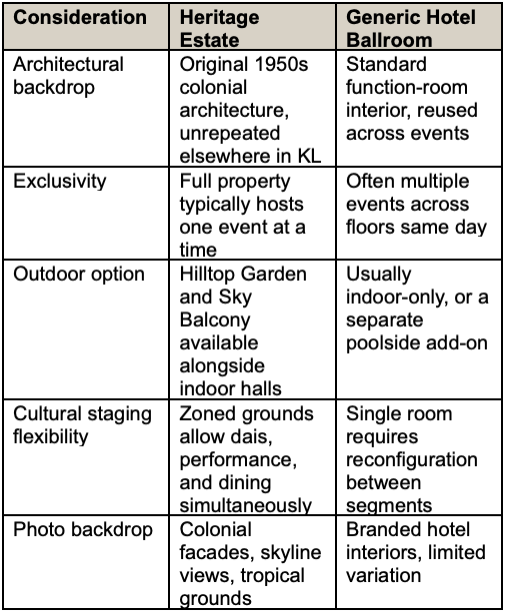
Built in 1950 as the residence of the General Managers of Socfin Group, and later used from 1965 to 1980 as an official residence hosting Malaysian government dignitaries, the property carries over 70 years of history that a newly built or newly renovated hotel ballroom simply cannot manufacture — it was converted into a dedicated event venue only in 2019, meaning its architectural character predates its life as a wedding venue by nearly seven decades. For couples still weighing indoor versus outdoor entirely, the site's existing piece on garden weddings in Malaysia is a useful companion read before narrowing down a specific space.
Malay weddings in Kuala Lumpur cluster around specific peak periods — school holidays, long weekends, and the months following Ramadan tend to book out venues with strong bersanding-ready spaces well in advance. Locking in a date and a specific space (Great Hall for an indoor formal reception, Hilltop Garden for a large open-air one) six to twelve months ahead gives enough runway to coordinate the vendors a bersanding depends on: a caterer experienced with Malay cuisine and halal requirements, traditional performers, and a pelamin/decor stylist who can work with the room's existing architecture rather than fighting it.
The venue's team coordinates directly with outside vendors on setup logistics, AV needs for speeches and performances, and the day's overall run of show, so couples aren't left translating between separate suppliers who've never worked in the space before.
For couples who want to see what a full bersanding day actually looks like in practice — from morning preparations through the evening reception — the site's Malay Wedding Day case study walks through a real composite day at the Estate. And for those still comparing this venue against how other wedding traditions are hosted on the same grounds, the Multicultural Weddings FAQ maps every major tradition — Malay, Chinese, Indian, and Muslim ceremonies — to the specific space that suits it best.
Bersanding is the enthronement ceremony of a Malay wedding, where the bride and groom are seated together on a raised dais, or pelamin, while family and guests process past to offer blessings. It typically follows the akad nikah solemnisation and forms the visual and social centerpiece of the wedding reception. The ceremony is processional and public by nature, which is why the space hosting it needs clear sightlines and room for guests to move.
Yes — many couples hold the morning akad nikah solemnisation and the bersanding reception at the same property on the same day, using different spaces for each. A smaller room such as the Private Room can host the more intimate solemnisation, while the Great Hall or Hilltop Garden hosts the larger bersanding reception later. For a full walkthrough of the solemnisation itself, see the Nikkah ceremony checklist.
Guest counts vary widely, from intimate gatherings of 30-50 close family members to large multi-generational receptions of 300 or more. Because Malay weddings often involve extended family and community guests, the venue chosen needs to scale accordingly — which is why having spaces ranging from the 800 sq ft Private Room up to the 9,000 sq ft Hilltop Garden on one property matters.
For an indoor, air-conditioned bersanding, the 3,100 sq ft Great Hall offers a formal backdrop sized for 50-100 guests. For a larger open-air reception, the 9,000 sq ft Hilltop Garden fits 150-350 guests with the dais as the centerpiece of the grounds. Smaller family-only celebrations suit the 800 sq ft Private Room, while the Sky Balcony offers a semi-outdoor option with a skyline backdrop.
---
Planning a bersanding reception in Kuala Lumpur starts with seeing the spaces in person — how the light moves through the Great Hall in the afternoon, how the Hilltop Garden opens onto the skyline at dusk. Book a private site visit to walk the grounds at 333 Jalan Damansara, Federal Hill, and talk through which space fits your guest list and cultural staging needs.