
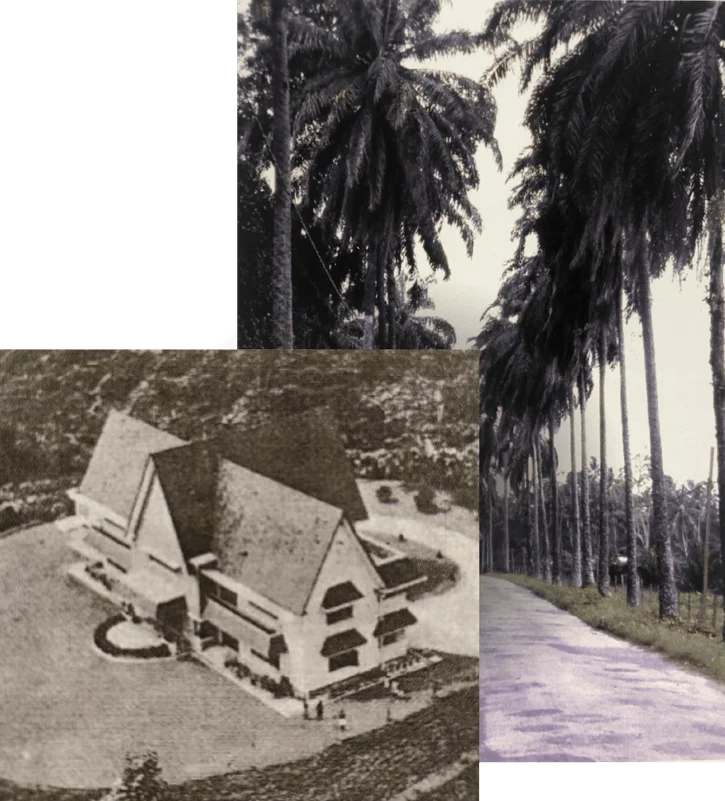
The Estate on Federal Hill was built in 1950 as a private residence known as "The White House," and its colonial-era architecture is not a decorative theme layered onto a generic event space it is the actual building, unaltered in its bones, that couples and event planners are working with. That distinction matters more than most styling guides admit. A hotel ballroom can be dressed up to look heritage for an evening; a 1950s colonial mansion on Federal Hill simply is heritage, with real proportions, real materials, and seventy-plus years of history embedded in its walls.
That history is specific, not decorative. The property served as the official residence for General Managers of Socfin Group, a plantation company that has operated continuously since 1904. Between 1965 and 1980, it passed to the Malaysian government and hosted dignitaries and distinguished guests a period that left the building with genuine formality baked into its architecture, from the scale of its reception rooms to the way its verandahs frame the surrounding rainforest hillside. It was only converted into an event venue in 2019, which means the architecture predates the events business by nearly seventy years.
For couples and planners, this raises a practical question: how do you style a celebration inside a building with this much inherited character without either ignoring it or burying it under decor? This guide walks through the real architectural story of the property, breaks down how each space reads architecturally, and offers concrete styling principles for working with colonial design rather than fighting it.

Understanding why the building looks and feels the way it does starts with its origin. Constructed in 1950 as "The White House," the property was designed as a residence not a public venue which is precisely why its interior proportions, room flow, and material choices feel more like a grand private home than a commercial event hall. This residential DNA is something no purpose-built ballroom can replicate; it's the reason guests instinctively lower their voices and slow down when they walk in.
The building's association with Socfin Group, active in the plantation sector since 1904, connects it to one of the longer institutional histories in the region. As the official residence for the company's General Managers, the house would have been furnished and maintained to entertain business guests and visiting executives a legacy of hospitality that, whether by coincidence or not, is exactly what the space is used for again today. When the property transferred to the Malaysian government between 1965 and 1980, it took on an even more formal role, hosting dignitaries and distinguished guests. You can read the fuller account of this timeline in our full architectural history, which documents the property's transitions decade by decade.
What makes this different from most venues marketed as "heritage" in Kuala Lumpur is that none of this is retrofitted narrative. The Estate on Federal Hill sits on 9 acres of tropical rainforest plantation land, and its conversion into an event venue in 2019 changed its function, not its architecture. The colonial-era structure high ceilings, generous verandah transitions, and a layout built for entertaining was already there, waiting to be used for exactly this purpose again.
Quotable fact: The Estate on Federal Hill has stood for more than 70 years, transitioning from a private colonial residence (1950) to a government dignitary residence (1965–1980) to an event venue (2019) three distinct chapters under one unaltered roof.
Each space at the venue carries a different architectural personality, and understanding those differences is the foundation of good styling. You can explore the full breakdown on the architectural highlights of the property, but here's how the four core spaces read in practice.
The Great Hall, at 3,100 sq ft and accommodating 50 to 100 guests, is the property's most formal interior space the kind of room whose scale and colonial detailing were built for seated banquets, ceremonies, and structured events. Its proportions favour symmetry: aisles down the centre, head tables framed by the room's existing architectural lines, and enough ceiling height that draping or elaborate rigging is rarely necessary to make the room feel grand.
The Sky Balcony, at 1,715 sq ft and suited to 70 to 100 guests, is where the building's colonial indoor-outdoor logic is most visible. Tropical colonial architecture was designed around transition spaces verandahs, covered terraces, breezeways that soften the line between inside and outside. The Sky Balcony continues that tradition while adding something the original architects never had to consider: panoramic KL skyline views as a backdrop for toasts, first looks, or cocktail hours.
The Hilltop Garden is the largest canvas on the property 9,000 sq ft, holding 150 to 350 guests and here the "architecture" is really the site itself: the rainforest hillside, the elevation, the framing of the house from below. It's the space best suited to large receptions, garden ceremonies, and events where the landscape does as much visual work as any styling. Finally, the Private Room, at 800 sq ft for 30 to 50 guests, is the most intimate interior space, where original colonial-era details mouldings, window proportions, the residential scale of the room are close enough to appreciate up close, making it well suited to small ceremonies or bridal preparation.
The single biggest mistake in styling a heritage venue is treating it like a blank box. The Estate on Federal Hill already has architectural lines, materials, and a colour temperature built in columns, high ceilings, and verandah-style transitions between rooms and the most successful events work with those elements rather than concealing them behind heavy drapery or oversized structural add-ons.
Lighting is where this principle matters most. Colonial architecture was designed for natural light and cross-ventilation, not stage rigging, so warm, low-intensity lighting schemes tend to flatter the period details far more than cold, high-output event lighting. Uplighting that highlights columns and archways, and warm-toned string or lantern lighting in the Hilltop Garden, tend to read as authentic to the setting rather than imposed on it particularly as the light shifts at golden hour and into evening, when the building's proportions and the skyline views from the Sky Balcony are at their most photogenic.
Florals and palette choices follow the same logic. Deep greens, ivory, brass, and warm neutrals tend to sit naturally against colonial stonework and woodwork, while overly modern materials — acrylic signage, neon, high-gloss synthetic finishes can visually fight the architecture instead of framing it. None of this means a heritage venue restricts a couple to a single aesthetic; it means the architecture sets a baseline the decor should acknowledge. For couples who want deeper design inspiration on this exact question, our historic buildings in Malaysia piece is a useful companion read on how period architecture and modern events coexist across the country's heritage sites.
Importantly, none of this styling work has to be figured out alone. Because event logistics including decoration services are coordinated directly through the venue, stylists and couples aren't guessing at what will or won't work with the building; the coordination process itself is built around protecting and complementing the architecture.
Quotable fact: The Great Hall's 3,100 sq ft footprint and the Hilltop Garden's 9,000 sq ft footprint were shaped by the site's original 1950s residential and landscape design not built to a generic banquet-hall template, which is why they photograph and function differently from a standard hotel ballroom.
It's worth stating plainly why any of this matters for a couple or company planning an event in 2026: authenticity is increasingly difficult to manufacture, and increasingly valuable when it's real. Kuala Lumpur has no shortage of polished, modern event spaces with glass facades and interchangeable interiors. What it has very little of is a colonial-era mansion with a documented, 70-year institutional history that guests can feel the moment they arrive.
The pairing of that history with panoramic KL skyline views is a genuinely rare combination a building old enough to have hosted government dignitaries between 1965 and 1980, set on a hillside with modern city views stretching out below it. That contrast, between the permanence of the architecture and the pace of the city surrounding it, is a large part of why the tagline "a sanctuary within the city" fits the property so precisely.
None of this heritage character comes at the cost of modern practicality, either. Full event logistics transportation, parking, AV equipment, decoration services, and a state-of-the-art kitchen for catering coordination are handled as part of hosting an event here, meaning couples and planners get the atmosphere of a colonial estate without sacrificing the operational reliability of a modern venue. For a closer look at how this property came to be reimagined for private events after decades outside public use, read the story of this hidden heritage building.
Quotable fact: The Estate sits on 9 acres of tropical rainforest plantation land in the middle of Bangsar's Federal Hill a scale of green space essentially unmatched by any hotel or convention venue inside Kuala Lumpur city limits.
If the architecture itself is part of why you're drawn to the venue, it's worth thinking early about how your specific ceremony will use the space. Couples planning an intimate Muslim solemnisation, for instance, often want to know how the Private Room or Great Hall accommodate a smaller, more traditional akad nikah within this colonial setting our Nikkah Ceremony Checklist walks through exactly that, step by step, from paperwork timing to how the space is arranged on the day.
And if you're still working out logistics capacity, what's included, how to request a quote the FAQ hub consolidates the most common booking questions in one place, including realistic capacity ranges for every space discussed above.
What year was The Estate on Federal Hill built?
The Estate on Federal Hill was built in 1950 as a private residence originally known as "The White House." It later served as the official residence for General Managers of Socfin Group before being transferred to the Malaysian government between 1965 and 1980, and was converted into an event venue in 2019.
Is The Estate a heritage-listed building?
The Estate on Federal Hill is a genuine colonial-era property with over 70 years of documented history, including a period as a government-held residence for dignitaries between 1965 and 1980. For the most current, authoritative status on any formal heritage designation, prospective clients should confirm directly with the venue via the inquiry page, as this guide focuses on the building's architectural and historical facts rather than legal listing status.
What architectural style is the venue?
The venue reflects mid-century colonial residential architecture typical of 1950s Malaysia high ceilings, verandah-style indoor-outdoor transitions, and a layout originally designed for private entertaining rather than commercial events. These features are still intact across the Great Hall, Sky Balcony, and Private Room today.
Can modern event decor be added without damaging heritage features?
Yes. Event logistics, including decoration services, are coordinated directly through the venue, which means additions like lighting, florals, and staging are planned around protecting the existing architecture rather than working against it. The general styling principle is to complement colonial details columns, ceiling height, natural light rather than concealing them under heavy structural builds.
If you'd like to see how the light moves through the Great Hall or how the Hilltop Garden frames the KL skyline before you commit to a styling direction, the best next step is to experience it directly. Book a site visit to walk the property at Federal Hill, 333 Jalan Damansara, Kuala Lumpur, and see firsthand how a genuine colonial estate takes to modern celebration design.